
The North-east
Mananara Nord
The North Mananara Biosphere Reserve is situated within a defined area, bordered to the north by the town of Mananara Avatra. This National Park consists of two distinct sections. The primary section is located on Grande-Terre and encompasses various forests (such as Verezanantsoro Forest, Ivontaka South, Ivontaka North, and those near the Anove River). The secondary, smaller section includes Nosy Atafana islands (facing Sahasoa village) and the surrounding reefs.
The Biosphere Reserve spans about 140,000 hectares, with the National Park covering 23,000 hectares and an additional 1,000 hectares of Marine Park that includes nearby islands and reefs. It stands as the largest protected lowland rainforest block in Madagascar.
Geographically, the reserve is located in a region characterized by crystalline hills (Antongil granites and Mananara migmatites). Along the coast between Anove and Antanambe, there stretches a sandy shoreline. North of Antanambe, beaches become more sparse and secluded. The rugged coastline is fringed by reefs extending nearly 200 meters from shore. The Nosy Atafana island group also boasts a submerged fringing reef.
Hotels
Maroantsetra and the Masoala peninsula
Masoala is a protected area complex spanning 240,520 hectares. It comprises four land parcels and three seascapes, forming part of the Atsinanana forests, a UNESCO World Heritage site. The Masoala complex, including the Masoala National Park and Nosy Mangabe Special Reserve, stands as the largest protected area in Madagascar. The region features islands of forest and rocks, coral reefs, seagrass areas, and mangrove forests.
Masoala boasts exceptional biodiversity, hosting over 50% of Madagascar’s plant species and more than 50% of its mammal, bird, amphibian, and reptile species. The park records 102 bird species, with over 60% being endemic. Among its 10 lemur species, four are critically endangered according to the IUCN Red List. Notably, Masoala is the sole habitat for the mongoose Salanoia concolor, a poorly understood Malagasy carnivore.
The Masoala Sea supports humpback whales, southern right whales, bottlenose dolphins, and pink-bellied dolphins. The Dugong, a type of Sirenia, also inhabits these waters. Additionally, Masoala hosts 41 genera of corals, alongside diverse reptiles, amphibians, sea turtles, and marine and freshwater fish.
Hotels



Nosy Mangabe
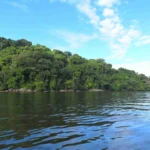
Discover Nosy Mangabe Special Reserve in Madagascar with Ortour Madagascar. Nosy Mangabe is a small island (520 ha) ensconced in dense, humid forest. Despite its remote natural beauty, remnants of ancient human inhabitants remain: explore Antimaroa family tombs nestled deep in the forest, and uncover 17th-century Dutch sailor engravings along the coast.
Nosy Mangabe harbors four species of lemurs-black and white lemur, brown lemur, aye aye, mouse lemur—including nocturnal varieties. Witness the elusive Uroplatus, a marvelously camouflaged lizard, and encounter the world’s smallest chameleon, the diminutive Brookesia. Rare species like the Aye-Aye thrive here, making Nosy Mangabe a premier destination for lemur enthusiasts.
With its pristine golden sandy beaches and verdant emerald forests where lemurs swing through the canopy, Nosy Mangabe promises a unique and unforgettable experience. Join Ortour Madagascar to witness humpback whales swimming in the bay, completing the magic of this exceptional island.
The East coast
Madagascar boasts unique flora and fauna concentrated in its eastern rainforests. Experience the beautiful green landscape of rugged mountains and interact with the friendly people. Indulge in abundant fruits and seafood, relax on pristine white sand beaches, and discover diverse plant life.
Mantadia Andasibe
Mantadia and the Analamazaotra Special Reserve together form the Andasibe Mantadia complex, covering 15,480 hectares. Originally one entity, these protected areas are now distinct due to human pressures.
Wildlife Sanctuary in Mantadia
Mantadia Park serves as a crucial sanctuary for diverse wildlife. It hosts 108 bird species, including the vital pollinator Terpsiphone mutata. The park also shelters 14 lemur species, 51 reptile species, notably the famous Boa mandotra, and 84 amphibian species.
Insect Diversity
Insects are pivotal in Mantadia’s ecosystem, serving as pollinators and recyclers. Lepidoptera and Coleoptera, including the rare Urania madagascariensis, dominate the insect population.
Flora and Fauna
Mantadia’s lush forests are home to diverse flora like lianas, epiphytes such as orchids, mosses, and ferns. The park boasts over 100 orchid species, with some exotic varieties introduced successfully. However, invasive species like Chinese guava and Rubus mauricana threaten certain areas, while Eucalyptus, pinus, and bamboo thrive along its borders.
Plan Your Visit
Discover the wonders of Mantadia and Analamazaotra Special Reserve with Ortour Madagascar. Experience the beauty of Madagascar’s wildlife and flora firsthand.
Hotel
Pangalane (Manambato)
Discover Dream Nest, or Akanin ny Nofy in Malagasy, a serene paradise nestled along Madagascar’s eastern coast. Spanning fifty hectares alongside Lake Ampitabe, part of the Pangalanes channel, this haven offers unparalleled tranquility.
The highlight of Dream Nest is its proximity to Palmarium, a private reserve spread over 30 hectares on Lake Ampitabe. Home to over 100,000 endemic palm trees, including rare species like Dypsis, Ravenea, Orania, Voanioala, and Lemurophoenix, Palmarium also hosts various species of lemurs. Notable inhabitants include the majestic Indri Indri, the largest lemur globally, Varecia variegata, Propithecus, and the endangered Aye Aye and Microcebus.
Crossing the 665 km Pangalanes channel is an unforgettable experience, bordered by lush vegetation typical of eastern Madagascar. This verdant landscape thrives with lychee, cinnamon, coffee, cocoa, and vanilla plantations, all nurtured by abundant rainfall.
Hotel
TOAMASINA (Tamatave)
Toamasina is the capital of the eastern region of the island of Madagascar, located 365km from Tana. Toamasina serves as the main port of Madagascar and is one of the 6 major cities (province) of the country. The dominant ethnic group in the region is the Betsimisaraka, the second largest in Madagascar. The climate ranges from hot and humid to rainy throughout the year. The fertile soil is perfect for vanilla, coffee, cloves, bananas, lychees, and rice. Toamasina boasts a splendid view along its coconut and palm-lined boulevard.
The Eastern region of Madagascar is characterized by dense tropical forests, tropical scents, and lush greenery, offering abundant sun and natural beauty. The local population of the Eastern region is known for its warmth and friendliness.
Hotels
Mahambo
Located 96 km from Tamatave, to the north, Mahambo has beaches open to a compartment and a lagoon. It is a famous relaxation spot for diving and canoeing.
Sainte-Marie (NOSY BORAHA)
Sainte Marie is 50 kilometers long and 7 kilometers wide. It is a vacation destination most preferred by vacationers due to its sandy beaches, its exuberant vegetation, and its spice gardens cultivating vanilla, cloves, and cinnamon. Here is a snapshot of a tropical island with endless deserted beaches overlooked by coconut palms, bays protected by coral reefs from sharks, hills covered in lush vegetation, and a relative absence of tourism development. The island offers scuba diving and the water sports are a paradise for whale watchers as they pass by to bask their calves in the vicinity.
Activities:


